Preparing Your Home for the Holiday Season

Holiday plans are in full swing for many of us, with the bustle of buying presents and readying homes for an endless stream of friends and family members. While you’re busy preparing menus and wrapping the last of the gifts for loved ones, you might want to add one more task to your “to-do” list before all of your gatherings begin. You need to ensure that your HVAC system is in prime working condition.

Preparing Your HVAC Unit for Holiday Traffic

The worst time for your HVAC system to break down is over the holidays. Unsavory odors, poor air quality, and a complete system breakdown can really wreak havoc on your Yuletide cheer. Fortunately, taking some simple steps to prevent an untimely issue with your HVAC will allow you to focus on more pressing matters, such as creating warm memories with your loved ones.

Simple Steps for Holiday HVAC Preparation

With this quick and easy holiday HVAC checklist, you’ll ensure that your home is comfortable and ready for any holiday event you host. Follow these preparation steps for HVAC success.

Clean the Ductwork

Dirty and clogged air ducts interfere with the airflow from your central HVAC unit. A quick inspection and cleaning of your ductwork will keep your home smelling fresh and free from excess debris. Clean ductwork also allows your central HVAC unit to perform more efficiently.

Inspect and Replace the Air Filters if Necessary

Your furnace air filter is hard at work, pulling dirt, mildew, mold, pollen, and other allergens from the air that you breathe. While it’s ideal to replace your furnace air filter regularly, the reality is that this doesn’t always happen. Now is a great time to inspect that filter for tears, cracks, and visible signs of pollutants. If any of these are present, consider replacing your filter to improve air quality and HVAC system function overall.

Keep the Vents Clear

Ensure that the Christmas tree and packages don’t block the floor air vents. Also, check that furniture, rugs and curtains are not blocking the airflow.

Seal Up the Leaks

Air leaks occur when outside air seeps into your home or heated air escapes through small cracks around windows and openings in your roof. An air leak can be a contributing factor to an increased number of pollutants in your home, leading to sniffles, coughs and allergic reactions. Inspect your home and HVAC unit for air leaks and seal them to improve air quality and heating efficiency and even reduce energy costs. Use caulk and weatherstripping to keep your home sealed up tightly.

Check the Thermostat and Regulate the Humidity Levels

The presence of extra moisture in your home can cause the development of mold, mildew, and other pathogens that thrive in warm, moist places. All that extra cooking and baking is bound to release extra moisture that circulates through your system. If your thermostat has an adjustable humidity setting, you might want to lower it a bit. Another option is to install a dehumidifier in rooms that are prone to extra moisture, such as the kitchen and bathroom, to offset any potential growth of these harmful substances in your HVAC system.

Don’t Wait Until Company’s Coming!

Performing regular, scheduled maintenance on your HVAC system year-round could eliminate the need for an extra service call around the holidays. If your system is cleaned and maintained regularly, it will continue to work for you when you need it most. We offer a three-tiered maintenance plan, allowing you to stay within your budget and pick the best plan. Signing up for one of these plans will help reduce repair bills and middle-of-the-night emergency phone calls. It will also help prevent you from sitting in a cold house during a fierce Indiana snowstorm as you wait for help to arrive.

Making Your Holidays Even Cozier!

Dugan Air provides expert HVAC service and installation for valued clients in Franklin and the surrounding areas. With offerings such as system maintenance plans, repairs and installations, emergency services, smart thermostat sales and service and air purification products. We provide you with the best heating and cooling solutions for your home. If company is coming, take one thing off your plate as you prepare. Contact Dugan Air today for an inspection of your HVAC services and start the season off right!

5 Things You Need to Do When Winterizing Your Home

When the temperatures start to cool down, you may be thinking about what you can do to get your home ready for the colder weather. By taking the time to winterize your home now, you may be able to avoid some costly repairs in the future. While it can take at least several hours to tackle winterization tasks, it will ensure that the interior of your home stays warm even when the temperatures start to drop outside. There are five tips that you can utilize to make winterizing your home easy.

1. Assess Your Gutters

It’s not uncommon for many homeowners to forget about checking their gutters when winterizing their homes. If there is too much debris in them, they won’t be able to divert rain or melted snow away from your home. This can eventually lead to issues with the foundation. Climb up on a ladder to look for things blocking your gutters, like leaves or branches. You should also check to make sure that your gutters are securely attached to your house. If they are too loose, then they could fall if you get a big snowstorm. If you aren’t comfortable cleaning or making simple repairs to your gutters, you can hire a professional to do it for you.

2. Have Your Chimney Cleaned

When it’s frigid outside, your chimney can provide a lot of warmth to your home. However, a buildup of soot can increase the risk of a chimney fire. Therefore, you need to have your chimney cleaned well before you plan on using it. While a chimney sweep is cleaning it, the professional can also inspect it to ensure that the flue works properly and that there isn’t any interior damage that needs to be addressed. Even if you don’t use your chimney very often, you should still have it cleaned at least once a year.

3. Schedule HVAC or Furnace Maintenance

You don’t want your heat to go out in the dead of winter. Because of this, you should schedule HVAC or furnace maintenance when you are winterizing your home. Regular maintenance can help you avoid certain issues, and our technicians at Dugan Air Heating Cooling can look for problems that need to be corrected. Even if it doesn’t appear as if you have any issues with your HVAC system or furnace, it doesn’t mean that there isn’t some sort of problem that will become bigger and more expensive to fix later on.

4. Drain and Cover Outdoor Spigots

Freezing temperatures can damage your pipes and outdoor spigots. Fortunately, you can easily winterize them yourself in a short amount of time. To begin, you will need to find the shut-off valve that’s located inside your home. Once you shut it off, you can turn your hoses on to drain out all the water. Wait a few hours so that they can fully drain. Turn them off, then inspect the spigots to make sure all the fittings are in good shape. If needed, make any needed repairs. Put a faucet cover over the top of each spigot. This will help insulate them and keep them from sustaining damage once the temperatures drop below freezing.

5. Check Your Window and Exterior Door Seals

Many people don’t realize that drafty windows and doors can really cost them a lot of money. Even small leaks will let cold air in, and this will make it more difficult to keep your home at a comfortable temperature. You can easily check the seals on your windows and doors by walking in front of them and putting your hand near where they shut to see if you can feel any air. If you do, you can simply replace the weatherstripping. This is also the perfect opportunity to walk around the exterior of your home to look for any gaps or cracks that need to be filled with exterior caulking.

If you haven’t begun the process of winterizing your home in Franklin, IN, now is a good time to start. While you can complete some of these tasks yourself, we can help you with all your heating and cooling needs. We also offer UV lights, air purifiers, humidifiers, and more. Our licensed technicians can do everything from providing general maintenance and repair to replacing your entire system. Call us at Dugan Air Heating Cooling today so that we can make sure your HVAC system is ready for winter.

Everything You Need to Know About Home Air Purification

Are you concerned about the quality of the air in your home in Franklin, IN? If you or a loved one suffers from allergies, asthma, or another respiratory condition, it’s important to ensure the air in your home is as clean and pure as possible. One way to do this is by investing in a home air purifier. Here are some common questions about home air purification.

What Is an Air Purifier and How Does It Work?

An air purifier is a device that helps to improve indoor air quality by trapping harmful airborne particles and pollutants. These contaminants include dust, pollen, mold spores, pet dander, and smoke particles. Air purifiers pull in dirty air and pass it through a filter. The filtered air is released back into the room, and the contaminants are trapped in the filter.

Do I Need an Air Purifier?

If you’re concerned about the air quality in your home, an air purifier can be a great way to help improve it. An air purifier can be especially beneficial if anyone in your household suffers from allergies, asthma, or another respiratory condition. Other signs that you might need an air purifier include excessive dust in your home, musty or stale odors, and visible mold growth. An air purifier can also be a good choice if you live in an area with high levels of outdoor pollution or if you smoke cigarettes.

How Do I Choose an Air Purifier?

When choosing an air purifier for your home, you’ll need to decide what type of unit you want and what features are important to you. The three main air purifiers are mechanical filters, activated carbon filters, and ozone generators. Some units also come with additional features like UV lights, which can help to kill bacteria and viruses.

Mechanical filters are the most common type of air purifier. They use a mesh or paper filter to capture contaminants as they pass through the unit. Activated carbon filters effectively remove odors and chemicals from the air; they work by adsorbing pollutants onto their surface. Ozone generators release ozone gas into the air. This gas oxidizes contaminants, which effectively destroys them.

How Often Should I Use My Air Purifier?

The frequency of use will vary depending on several factors, including the type of air purifier you have, the level of pollution in your home, and your personal preferences. However, most air purifiers need to run continuously to be effective.

The best way to determine how often to use your air purifier is to consult the manufacturer’s directions. They can give you specific guidance based on the type of air purifier you have and the conditions in your home. By following their recommendations, you can ensure that your air purifier works optimally and that your home’s air quality is high.

What Are Some Common Maintenance Tips for Air Purifiers?

It’s important to replace the filter to keep your air purifier working properly. Depending on the type of filter and the level of contaminants in your home, you may need to change it as frequently as every month or two.

In addition to replacing the filters, you’ll also need to clean the unit regularly. Depending on the model, this might involve simply wiping the exterior with a damp cloth or using a vacuum attachment to remove dust inside the unit. Consult your owner’s manual for guidance on cleaning your particular air purifier model.

Also, be sure to allow for proper airflow. Air purifiers rely on a steady flow of air to work effectively, so keep the area around the unit clear of clutter. In addition, ensure no gaps or cracks in the ductwork leading to and from the unit.

Are There Any Health Risks When Using an Air Purifier?

When used properly, air purifiers are safe for most people. However, there are a few potential health risks to be aware of. If you have asthma or another respiratory condition, it’s important to consult your doctor before using an air purifier. In some cases, using an air purifier can trigger asthma attacks or other respiratory problems.

Ozone generators release ozone gas into the air. This gas can be harmful to your lungs if you’re exposed to it for too long. For this reason, it’s important to choose an ozone-free air purifier or one with a low ozone gas output.

An air purifier can be a great way to improve indoor air quality and create a healthier environment for your family. If you have any questions about home air purification, Dugan Air of Franklin can help. We will help you choose the right unit for your home and provide guidance on how to use it properly. We also offer heating and cooling repairs, installations, and maintenance services as well as services for heat pumps. Contact us today to learn more!

How to use space heater

How to Use a Space Heater Efficiently

Using a space heater is simple: just plug it in, turn it on, and voila, heat! They’re an excellent short-term solution to heating a small space, like a home office or bedroom, providing adequate, temporary warmth within minutes. However, using these heaters comes with some risks. Read on to learn how to use a space heater safely and efficiently when you need to heat a space for a short time and when to call Dugan Air Heating and Cooling for furnace repair.

Space Heaters: A Temporary Heating Solution While Your Furnace Is Down

Space heaters are convenient, portable options when your central heating is unavailable. They work by radiant heating or convection, operating between 10,000 and 40,000 BTU per hour, running on electricity, natural gas, propane, or kerosene. They’re an excellent temporary heating solution when you need additional heat in a small space.

dugan air_How to Use a Space Heater Efficiently

Choosing the Right Space Heater for Your Home

It’s important to choose a space heater suitable for the size of the room you want to heat and always to make sure you have proper venting available if you use a gas, propane, or kerosene-powered heat source. Safety features you’ll want to consider are tip-over switches that automatically turn the heater off if it topples over and overheat protection for additional fire safety.

How to Use a Space Heater Efficiently

Due to their small size, space heaters work best in smaller, confined spaces, like in a corner or under your desk. Choose a heater that’s the right size for the space and uses a lower wattage, so it’ll consume less electricity while heating the room, and close the doors to keep the from escaping the space. 

Safety Tips for Space Heaters

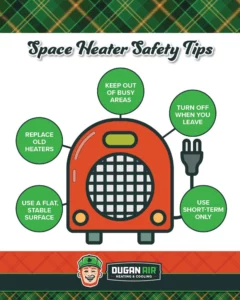
Space heaters cause over a thousand house fires annually in the US, or around 46% of all home-heating-related fires. The following are some practical tips on keeping safe when using a space heater in your home: 

1. Put your space heater on a level surface 

Start by setting your space heater up on a flat, level surface. Make sure that both your space heater and anything supporting it is stable and that your heater is at least 3 feet away from walls and flammable items. If you have thick carpeting, avoid putting the space heater directly on it.

2. Turn your heater off before leaving the room 

Modern space heaters are designed with automatic emergency shut-off functions and built-in timers. However, these features aren’t reliable substitutes for having someone present to resolve the problem if it overheats, malfunctions, or tips over while it’s on.

3. Avoid using space heaters in busy, high-traffic areas 

Don’t set up your space heater in any area that gets a lot of foot traffic. It’s best to use these appliances in small rooms occupied by one or two people to avoid accidental tipping. Some models have exteriors that get hot, so it’s important to keep them out of the path of kids and pets to reduce the risk of injury.

4. Upgrade your outdated space heater 

Old, outdated space heaters are much more likely to malfunction than brand-new ones. They may lack important safety features like automatic emergency shut-offs, timers, and heat-resistant covers. If you have an old, dust-covered space heater, give it the retirement it deserves. Space heaters aren’t expensive, and having a modern, feature-rich model can save you a lot of trouble.

5. Use a space heater as a short-term solution  

Space heaters are handy when remote rooms like basements, garages, and converted attic spaces aren’t warm enough in the winter. However, they aren’t effective primary or long-term heating solutions. If your furnace is underperforming or no longer working, replacing it is much safer and far more efficient than using a space heater. You’ll spend less money in the long run and improve your home’s value, appeal, and habitability.

Can You Leave an Electric Heater On Overnight?

No, leaving the electric heater on overnight is unsafe, as it puts you at risk of a fire. The components inside a space heater get too hot when left on too long, and if you’re asleep, you won’t notice if something catches on fire. If your heat goes out and you can’t access emergency heating repair, it’s safer to dress warmly and use multiple blankets instead.

It’s also important to note that when Franklin winters are at their coldest, a space heater won’t have the capacity to heat your entire home. With no central heating system, residents run the risk of developing hypothermia. Attempting to run multiple space heaters at once can overload your electrical system. It also greatly increases the risk of fire.

Call Dugan Air Today

At Dugan Air, we offer reliable indoor air quality and heating and cooling services to residents of Franklin, IN, as well as surrounding areas. We’re committed to helping our clients stay safe and save money throughout the winter season. If your central heating system isn’t working as it should, we can help. Contact us today to find out about our furnace repair and replacement services.

Frequently Asked Questions

Can I use a power strip with my space heater?

No, using a power strip or extension cord with a space heater is dangerous. Power strips aren’t designed to withstand a space heater’s heat, and most don’t have the appropriate current rating to provide safe power. This will cause it to overheat quickly and start a fire. 

You should always plug your space heater directly into wall outlets, and for safety’s sake, your space heater’s plug should be the only cord plugged into the outlet to avoid overloading it.

What should I do if my furnace breaks down?

Call a trusted local HVAC repair company if your furnace breaks down. Dugan Air Heating & Cooling is Indiana’s go-to choice for homeowners, thanks to our high service standards and dedication to customer care.

What is a SEER Rating and How Does It Affect My Home’s AC System?

When you’re looking to invest in a new air conditioning system, one of the very first things that you’ll likely be concerned about is its energy efficiency. Energy costs always seem to be going up. You want to ensure that you pick a system that is affordable to run, which is why understanding the SEER rating scale is vital.

What is a SEER Rating?

SEER stands for season energy efficiency ratio. Each air conditioner that is sold will have this SEER rating, which will help you as a buyer to determine how energy efficient the system is. SEER is determined by taking the unit’s total cooling output for a whole season and dividing it by the system’s total energy usage in that same season.

It’s easiest to think about this rating as miles per gallon in a car. A car that gets more miles per gallon than others is considered more efficient and less expensive to run. The same holds true for a higher SEER rating air conditioner. These ratings run from a minimum of 13 to a maximum of 25 for centralized air conditioning systems. Mini-split ductless units have even higher efficiency ratings.

It’s crucial to note that the minimum standard for all air conditioners set by the federal government is 13 SEER. Energy Star air conditioners have a SEER rating of 14.5 or higher. Most typical units will have a SEER of around 16. If you’re looking for a high-efficiency system, then you’re going to want to get a SEER of 19 or more.

SEER is Considered a Maximum Operating Efficiency

It’s important to realize that a system’s SEER rating specifies its maximum operating efficiency. It’s highly unlikely that your system will always operate at its SEER rating. Think of your air conditioner like your car. If you’re operating in the city, your car is going to get much less gas mileage than when you’re operating on the highway. If your air conditioner’s filter is dirty, it’s not going to operate at maximal efficiency and so forth.

What SEER Rating is Best For Your Home?

The simple answer is that it really depends. While purchasing a system with the highest SEER rating will ensure maximal efficiency, it can be very expensive for the average homeowner. Determining what SEER rating is ideal for your home depends on a number of factors. These include things like the amount of insulation you have in your home, how much you pay per kilowatt of energy, the size of your home, and so forth.

It’s typically best to approach investing in a new air conditioning system by being mindful of the performance of your old system. Most older air conditioning systems will have a SEER rating of 8 or 9. Just switching to the minimum of 13 or 14 for a modern-day air conditioner can drastically lower your energy bills. Take a few moments and assess your old air conditioning unit to determine its SEER rating so that you have a basis to start making decisions.

Benefits of Higher SEER Units

Investing in a higher SEER air conditioning unit comes along with many great benefits. The most obvious is that it will run on less energy, which means lower power bills for your home throughout the summer months. This can turn into a lot of cash savings if you’re switching from a lower SEER unit system to a much higher SEER unit system.

When you purchase a new air conditioning system that has a high SEER rating, you can cash in on some great tax rebates and incentives. Federal, state, and some local governments are offering these tax advantages to homeowners who are investing in more efficient systems to reduce their carbon footprint.

Another great benefit of high SEER units is that they come with modulating speeds. Most standard SEER units come with a one-speed operation. This doesn’t help to control humidity overly well, can be quite noisy, and can’t offer the specific level of comfort that higher SEER rating systems can.

Reliable AC Services

Dugan Air Heating Cooling offers reliable AC services for the whole Franklin, IN, region. We’re also available for all of your heating, thermostat, new construction, and air quality needs. Give us a call today to set up your next service appointment with our experienced technicians.

Choosing When to Install Your HVAC Unit

Replacing your HVAC system can be a monumental and costly task. However, it can be even worse for you if you try to replace it when it is already too late. Choosing the right time to replace your HVAC unit can make all the difference. Like most things in life, your HVAC system is most likely to break down when you desperately need it: during a heat wave or a snowstorm.

That is why you will need to replace your system before it fails. Planning ahead allows you to replace it at a time that’s convenient for everyone inside your home. After all, you don’t want to go through summer or winter without your system working.

Is There a Good Time?

As with anything in life, there are trade-offs when deciding when to replace your HVAC system. For example, it gets sweltering in Festus, MO, but it also gets really cold in the winter. That means you are bound to pay a massive cost when trying to replace your system in either one of these seasons. You might also think you can get your system through one more season before it needs replacing.

Many people pay over the market rate because they thought their system would make it through one more season, but it broke down in the middle of bad weather. When that happens, you can check with our experts at [company_name]. We can provide you with the heating repair, maintenance, and installation services that you need. We also do the same with air conditioning installation, maintenance, and repair. We provide services around the Festus, MO area.

The Off Season

The best time to have your HVAC unit installed is during the off-season. This is typically spring or fall or when it isn’t too hot or too cold to do without a system. During this time, since the overwhelming majority of people do not plan ahead, you will get much better rates on your HVAC system installation. You can get an affordable job done at an optimum time. The only question is whether or not you will want to replace your system if it’s not completely broken. This is an important question that our experienced technicians can help you answer.

Scheduling Ahead

As mentioned above, it is imperative to schedule ahead when installing your HVAC unit. If you don’t, you don’t get to control when the job gets done. You might end up in a long queue behind other people who did not think to plan ahead either. In peak months, HVAC installers are incredibly busy. That means it’s almost impossible for you to get served quickly and affordably. You might wait weeks for them to get around to your unit. Like many others, this is a seasonal business that needs careful consideration based on the condition of your system and where you live. Many people have found that they can save up to 15% by simply picking a good time to have their HVAC system installed.

Certain Times Are Cheaper

Is there a great time to replace the HVAC unit? The answer to that is a resounding yes. However, the nuanced view is to look at the weather in your local area and decide when your off-season is. It should be a decision you’re completely confident in because sometimes summer or winter might last a bit longer than you hoped. You will then be in a situation where you have to decide between enduring the harsh weather without your system or paying more to install it when it’s the most expensive.

Either way, we can help you get your HVAC system installed. Contact [company_name] to get started. We offer heating, cooling, and special services like water heaters, ductwork, and sheet metal fabrication.

How Much Does Ductless Air Conditioning Cost to Install?

How Much Does Ductless AC Cost to Install?

Ductless mini-split systems are an alternative to traditional central AC that eliminate the need for ductwork installation. Various factors influence ductless AC cost, but many homeowners enjoy enhanced home comfort and long-term savings on energy consumption. Explore how ductless air conditioning works, and get a tailored installation estimate from Dugan Air.

What is Ductless Air Conditioning and How Does It Work?

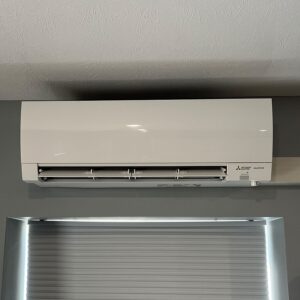
Ductless air conditioning, also known as a mini-split system, is a cooling system that doesn’t require ductwork to draw in or distribute air throughout your home. Instead, ductless air conditioning systems consist of an outdoor condenser and one or more indoor air handlers that distribute cool air directly into HVAC zones. The indoor air handlers, or heads, are mounted onto the floor, wall, or ceiling.

Mini-split systems use the same technology as heat pumps and AC units to cool air — an evaporator coil in each air handler houses refrigerant and absorbs heat from the indoor air. Outside, the condensing unit compresses and releases the heat. The cooled refrigerant travels back through the lines while the air handler utilizes the blower fan to distribute cooled air to the space. 

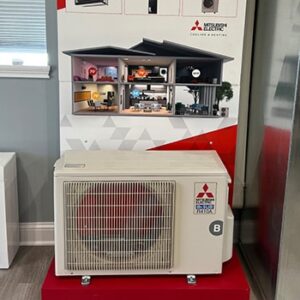
Mitsubishi Ductless Air Conditioner

One outdoor unit can connect to multiple indoor units. Conduits containing refrigerant lines and electrical wires connect the air handlers to the outdoor unit. Each indoor head features a thermostat and independently controls its zone. Many systems also provide heating, reversing this process to warm your home. 

What is the Average Cost to Install a Ductless Air Conditioning?

The cost of a ductless air conditioning system depends on several factors, but they average from $5,000 to $10,000 with installation. Multi-zone systems reflect the high end of the price range and can cost from $10,000 to $20,000, depending on the overall system size and number of zones. 

Your HVAC contractor can provide a precise estimate following their assessment of your home and its cooling needs.

Factors that Affect Ductless AC Cost

The number of zones or indoor units, system size, efficiency ratings, and other factors influence the upfront price of a ductless air conditioning system, but rebates and incentives can help offset these costs. Understanding these variables helps you choose the ideal system for your home.

Number of zones

Since each indoor air handler can usually only accommodate one room or zone, the number of zones or rooms will impact the cost. If you need to cool four rooms in your home, it’s likely you’ll need four indoor units. Most outdoor units can accommodate up to eight heads — after that, you may need multiple condensers, which adds to the overall price.

Other factors also influence the number of zones needed. For example, open floor plans may require multiple heads for expansive rooms. 

System size and capacity

The cooling capacity of a ductless AC is measured in British Thermal Units (BTUs). Most homes require about 20 BTUs per square foot, and a 500 to 600 square-foot space needs approximately 10,000 to 12,000 BTUs. Your home’s actual cooling load depends on insulation quality, the number of windows and doors, and the local climate. An HVAC technician can accurately calculate your home’s exact needs to ensure proper sizing.

Brand

Different brands offer mini-split systems at various price points. Some are more affordable than premium brands, for example, but may have limited reliability, efficiency, and longevity. Some Mitsubishi models, for instance, have more premium price points but provide cost savings in terms of superior energy efficiency, advanced features, enhanced convenience, and more comprehensive warranties.

Mitsubishi Unit

Efficiency rating

Seasonal energy efficiency ratio (SEER) ratings measure how efficiently a mini-split system cools a space. Higher SEER ratings usually translate to increased upfront costs, but investing in an energy-efficient unit can lead to long-term savings on your electricity bills.

Installation complexity

Various factors influence installation complexity. For example, wall-mounted units are usually the simplest and least costly to install, while ceiling cassettes or floor-mounted units may require more involved labor. Other complexity factors include:

  • Long refrigerant lines or electrical wiring.
  • Electrical panel upgrades.
  • Add-on smart home features.
  • Accessibility challenges.

Rebates and incentives

Government programs and utility companies often provide rebates and tax incentives for homeowners who upgrade to energy-efficient systems, such as ductless ACs. These incentives help offset the upfront cost.

What Are the Benefits of Installing a Ductless Air Conditioner?

Ductless air conditioning provides several advantages that make it a worthwhile investment for many homeowners.

Energy efficiency and utility savings

Leaky ducts in central AC systems can account for up to 30% of cooling energy costs. In comparison, ductless mini-splits eliminate energy losses associated with leaky ductwork. Ducted central AC and heat pumps don’t usually exceed about 26 SEER, but mini-splits can achieve up to 35 SEER. Over time, this energy efficiency reduces utility bills.

Versatility

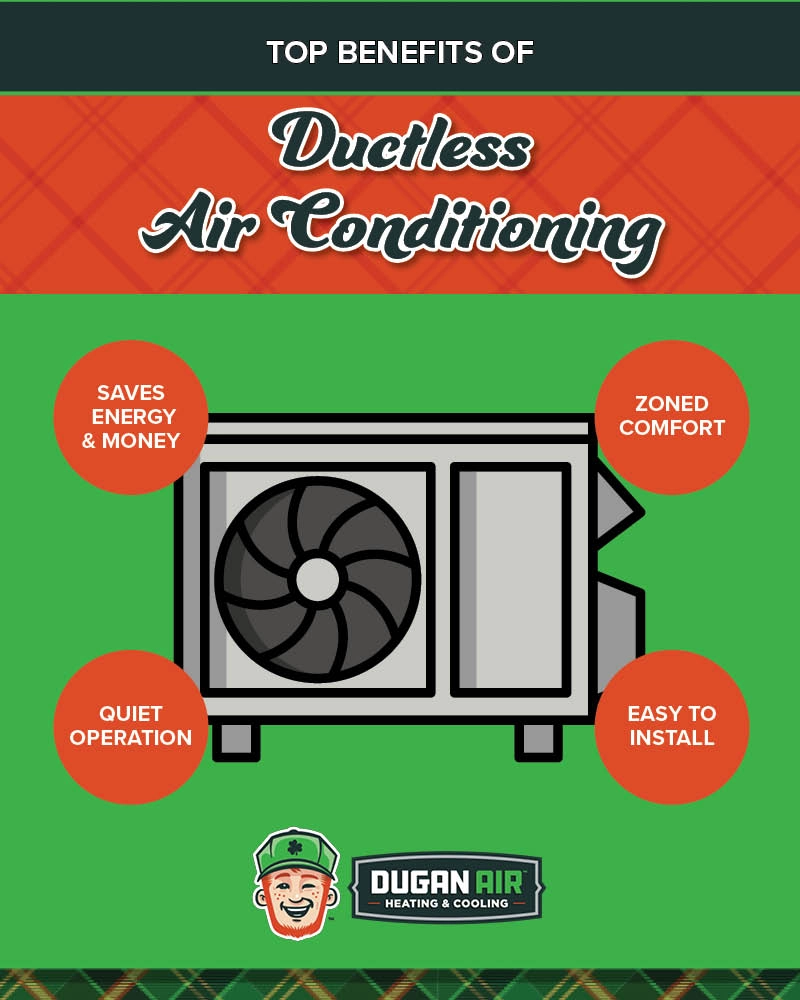
Because each head operates independently, you can set different temperatures in each zone. This capability allows for improved comfort and energy efficiency since reducing cooling in unused areas helps lower consumption. Many ductless AC systems are also heating systems, so they provide year-round comfort.

Quiet operation

Ductless systems are significantly quieter than traditional HVAC systems, benefiting homes with higher noise sensitivity.

Easy installation

Without ductwork, mini-split installation is significantly faster and less disruptive than central AC. Technicians drill small holes to run conduit lines and can mount the units quickly. This is ideal for older homes or home additions where ductwork installation may be less practical.

Why Choose a Diamond Elite Mitsubishi Contractor for Your Installation?

Working with the right contractor for installation is as important as choosing the right system. By choosing to work with a Diamond Elite Mitsubishi contractor from Dugan Air, homeowners can enjoy expert product knowledge and certified installation for proper sizing and placement. Working with a Diamond Contractor also provides access to exclusive extended warranties for eligible models.

Call Dugan Air for Ductless AC Installation

Ductless AC provides versatile and energy-efficient cooling for many homeowners, providing long-term savings and consistent comfort. Experience the Dugan difference for yourself, and contact us for expert and certified ductless AC installation.

7 Common Questions You Might Have About Air Purification

As a homeowner, you want the air inside of your home to be as safe and clean as possible to breathe. You need to remove impurities that can make the air dirty and might compromise the health of you and your family. Before you invest in an air purification system for your house, however, you may want to get some answers to some of your most pressing questions about it.

1. Can Air Purification Help Relieve Allergies and Asthma?

Air purification may help to relieve some or all of your allergy or asthma symptoms if they are caused by factors like dirt, dust, and pet dander that get in the air inside of your home. An air purification system is effective at removing these agents. Once the number of these agents is reduced in the indoor air, you might suffer less often from allergy flare-ups or asthma attacks.

2. Can Air Purification Remove Odors in My Home?

If your air purification system relies on an activated carbon filter, it can be effective at removing odors caused by factors like:

  • Cigarette or cigar smoke
  • Cooking
  • Dirty diapers
  • Rotting food
  • Kitchen garbage

You can use this system in areas of the house that experience foul odors most commonly. However, if your air purification has a HEPA filter in it, it might remove odors less successfully. A HEPA filter is more suited for removing allergens from the air inside of your home.

3. Will My Air Purifier Work for My Entire House?

Your air purification system may work for your entire house, depending on how large your property is and how many levels it has. The size of your air purifier can also determine how large of an area in which it can function. When you invest in an air purification system, you can find out how many square feet for which it is designed. You may opt for one that covers the largest amount of space if you want it to purify most or all of your home.

4. Can I Also Keep My Windows Open While I Run My Air Purifier?

You might like to open your windows and let in fresh air. However, when you run an air purifier in your home, you may cause it to work harder because it must remove the allergens, dirt, and dust that come in through the windows from the outdoors. When you want to keep the indoor air as clean as possible, you may open your windows less. You might instead opt to run your air conditioner to keep your indoor air cool.

5. Where Is the Best Area of the House to Use an Air Purification System?

You can effectively use an air purification system anywhere you want to clean the air in your house. Some people like to use these systems in the hallways and around the bedrooms where their children sleep. Others like to use these systems in and around the kitchen or living room to remove odors from cooking or smoking. It is important, however, that you place your air purifier away from areas where it can be obstructed with fixtures like draperies or doors.

6. How Long Should I Run My Air Purification System?

The length of time you run your air purifier will depend on factors like its size and the cleanliness of the air inside of your home. Smaller air purifiers typically benefit from being run for an hour or less at a time. Larger purifiers can tolerate being run for several hours.

7. Is Air Purification Noisy?

Air purifiers do make noise, much the same as air conditioners and heaters. However, their noise should not be overly bothersome. You may still be able to hold conversations and watch and listen to TV normally while running your air purification system.

[company_name] in Franklin, IN offers the heating, air conditioning, and ventilation services you need as a homeowner. You can rely on our professional technicians for services like installation and repairs of your heating and AC units. You can also have fixtures like thermostats serviced and get emergency repair services on the weekends or during overnight hours. Find out more about the services available for your home’s heating, AC, and ventilation systems by contacting [company_name] in Franklin today! We are looking forward to serving you.

Humidifiers: Good or Bad for Improving Air Quality?

Do humidifiers improve air quality? This is a question many people have been asking themselves lately and for good reason.

The simple answer is yes. When used correctly, humidifiers can make the air in your home more comfortable and lead to better air quality. Springtime means dry air, as well as high pollen counts, which can worsen allergy symptoms.

Dry air is a problem for your health. It can cause coughing, make you more susceptible to colds and flu, and aggravate allergies. Dry air also causes static electricity, which may seem like an annoyance, but can actually be dangerous — it’s a fire hazard.

How Humidity Affects Health

Humidity affects health when it’s either too high or too low. Dry air causes dry skin, sinus problems, and sore throats, among other issues. Extremely dry skin can lead to bleeding; extreme dryness of nasal passages can cause nosebleeds.

Too much humidity in the summer can lead to mold growth and damage to furniture and home structures.

A Healthy Solution

Humidifiers can solve these problems. They help people breathe easier when they have colds and congestion by loosening the mucus in their respiratory tract so it drains more easily. This helps those with asthma, bronchitis, and other respiratory ailments.

Moist air is healthier for you. In fact, doctors often recommend using humidifiers to improve indoor air quality as part of their treatment for respiratory illnesses and allergies. Airborne contaminants in dry air can make it harder to breathe, get sick more often, and stay sick longer. The Environmental Protection Agency (EPA) even found that using a humidifier in the winter can reduce your heating bills by up to 4%.

Increased moisture alleviates dry skin and eyes; chapped lips; cracked furniture; warped floors, window sills, and peeling paint. Humidifiers can also increase the efficiency of furnaces in the winter because moist air feels warmer than dry air at the same temperature.

How Humidifiers Work

These devices are designed to raise moisture levels in the air. They come in various sizes, from portable units to whole-house systems. The most basic models have a reservoir that holds water to be vaporized slowly into air by a fan. Cool mist models spray water into the air, while warm mist types use steam to raise humidity levels.

Different Types of Humidifiers

Humidifiers come in many types: tabletop humidifiers, whole-house humidifiers attached to your furnace or HVAC system, portable room humidifiers with large tanks that need refilling every day or two, ultrasonic humidifiers that create a mist using high-frequency sound waves, and cool-mist humidifiers that use fans or impellers to move water from the tank into a fine mist.

Maintaining Humidity Levels

The air quality in a home can be greatly improved by using a humidifier. However, it is important to remember that humidity levels should be monitored at all times so that mold, mildew and bacteria don’t grow from over-humidification.

Maintaining the proper humidity level in your home is important. When the air is too dry, it can cause skin irritation and lead to colds, coughs and other upper respiratory problems.

However, if you over-humidify your home, it can lead to mold growth, which will worsen any allergies you have and cause respiratory problems for everyone in your house. This is why it’s important to monitor the humidity levels in your home and ensure they are not too high or too low.

The key is to maintain moderate humidity levels, which vary depending on the area of the country you live in. For example, people in the Southwest, where the climate is hot and dry year round, should aim for 30% humidity, while those in the Northeast should aim for 40 percent.

A whole house humidifier is installed directly into your HVAC system (built into the ductwork of your home’s heating and cooling system) and will dispense water vapor throughout your entire house. This helps maintain a proper humidity level in every room of the house. Portable humidifiers offer a lot of flexibility, but they’re not as efficient as whole-house systems, particularly if you’re using multiple units throughout your house.

If you’re dealing with humidity issues in your home and are concerned with your indoor air quality, contact Dugan Air. Our team will come out and assess your home and suggest the appropriate system that will keep humidity levels comfortable for your family.

We provide service for Franklin and the surrounding areas: Greenwood, Bargersville, Martinsville, Nineveh, Morgantown, and more. We also offer services such as new installations, repair, maintenance, and emergency services for your heating and cooling systems.

Common Reasons Why Your Furnace Is Making Noise

Common Reasons Why Your Furnace Is Making Noise

Located just 20 minutes from Indianapolis, the city of Franklin, IN experiences cold winters that require homeowners to have a reliable furnace to keep warm. However, if you have a furnace that’s making noises like buzzing, banging, or whistling, it can be unsettling. That said, there are a few common reasons why your furnace is making noise, ranging from a blower motor issue to a clogged filter and more. The experts at Dugan Air Heating and Cooling are available to address all of your most pressing furnace concerns, including these unusual and annoying noises. 

dugan air_Common Reasons Why Your Furnace Is Making Noise

Common Furnace Noises and Why They Occur

Here are some of the most common furnace noises and what they mean.

Squeaking

If your furnace squeaks when turning on, it could be caused by a broken or damaged blower motor that hasn’t been cleaned or lubricated. Over time, the belt and blower motor bearings wear down or break, causing the blower wheel to scrape against the housing and produce a strange squeaking sound. If the belt and motor bearings are worn out or broken, it might also create a loud humming or rattling noise. 

Some other causes of squeaking noises coming from your furnace may include:

Loud boom or banging

Any sudden, loud booming or banging noises coming from your furnace are certainly cause for concern. This unsettling noise is often caused by dirty burners in your furnace, which should normally light and stay on while the furnace is in operation. However, if the burners are dirty or damaged, gas can build up inside the chamber until the burner ignites, creating a small explosion that creates a loud bang or boom due to delayed ignition. 

Other possible causes of loud booms or banging sounds include:

  • Clogged gas lines
  • Low gas pressure
  • A faulty ignition system

Screeching or whistling

If you notice a furnace screeching noise or if your furnace is making a high-pitched noise like a whistling sound, it could indicate that your filter is dirty or clogged. Furnace air filters should be replaced regularly (typically every 30-90 days) to maintain good airflow and air quality. If your furnace struggles to get enough air through the system, the clogging from excess dust and other debris can produce a nagging screeching or whistling sound. 

Screeching or whistling noises may also be due to:

  • An air leak or blockage in the ductwork
  • A small leak in the gas line
  • Blocked air vents 

Buzzing or grinding

One of the most common problems associated with furnace noise is a buzzing or grinding sound, often caused by loose parts and components like bolts and screws. These parts may become loose or damaged if your furnace is jostled or dropped during delivery or installation, or it may happen over time due to normal wear and tear from constant system vibrations. The issue may get worse as more components loosen, causing more damage that may eventually affect the entire system.

Some other reasons why your furnace is making a buzzing noise may include:

  • A failing blower motor
  • A faulty capacitor
  • Electrical/wiring issues

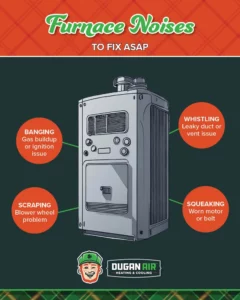
Furnace Noises That Should Be Addressed Immediately

Although some furnace noises are normal, others should be addressed immediately to prevent further damage to your system. 

  • Banging sounds: Loud banging or booming sounds are a sign of a gas buildup and ignition issues that should be addressed as soon as possible.
  • Scraping: Unusual metallic scraping sounds might indicate that your blower wheel is malfunctioning, which may lead to further damage if it’s not addressed.
  • Whistling: High-pitched whistling noises may be due to a leak in your ductwork or issues with the air intake vent, both of which should be taken care of quickly to improve system functionality and airflow.
  • Squeaking: This noise typically means your blower motor and/or blower belt is worn out and needs to be replaced ASAP. 

When to Call for Professional Furnace Repair

Here’s when to call Dugan Air Heating and Cooling for professional furnace repair. 

  • Unusual banging, grinding, rattling, or screeching noises come from your furnace and don’t stop
  • Some rooms of your home experience uneven heating
  • You notice a strong burning smell
  • There is a sudden increase in your monthly heating costs
  • The furnace won’t turn on or it runs constantly
  • You see visible signs of leaks or damage to your furnace
  • Your furnace is reaching the end of its lifespan (usually around 15 years old or older) and needs frequent repairs
  • The pilot light in your gas furnace is flickering and/or turning yellow instead of blue

Contact Dugan Air Today

Dugan Air Heating and Cooling provides top-quality heating and cooling services to customers in Franklin, IN, and the surrounding areas. Our unique blend of premium service and a fun, no-shenanigans approach allows us to deliver exceptional comfort to your home while providing a memorable customer experience. If your furnace is making noises and needs repair or replacement, contact us to schedule an appointment today!

Frequently Asked Questions

Is it safe to run my furnace if it’s making noise?

If your furnace is making noise, it’s best to turn it off and call for repairs ASAP. Loud banging and booming noises could indicate an issue with the gas supply, ignition, or burners which may pose a threat to your safety. Other noises may be due to a malfunctioning component that should be inspected and repaired or replaced to prevent further damage to your system. 

How do I stop my furnace from squeaking?

To stop your furnace from squeaking, try changing the air filter, inspecting and cleaning the blower motor, or tightening loose parts. If your furnace is still squeaking, call Dugan Air for help. 

Schedule Now

"*" indicates required fields

This field is for validation purposes and should be left unchanged.