Tag: Blog

Understanding Why Your Thermostat Is in Recovery Mode

Understanding Why Your Thermostat Is in Recovery Mode

Key Takeaways

  • Recovery mode makes your HVAC system start early, so your home reaches the temperature you set at the scheduled time. 
  • Seeing your thermostat in recovery mode is normal and helps you save on energy costs by gradually raising or lowering your home’s temperature.
  • If your thermostat enters recovery mode unexpectedly or for an extended period, there may be an issue with your HVAC system.
  • Dugan Air is here to help with all your thermostat and HVAC needs, providing quick repairs, professional installations, and preventative maintenance. 

What Is Recovery Mode on a Thermostat?

Modern digital thermostats have multiple functions and features, offering convenient programming options, helpful automation, and user-friendly setup. However, these functions sometimes include alerts or modes that may catch your attention.

If you’ve noticed your digital thermostat is in “recovery mode,” it’s usually not something to worry about. While certain scenarios may require further attention, most of the time it’s just a setting or schedule that needs adjusting. Learn what recovery mode means on your thermostat, why it happens, and when it’s an issue that needs your attention.

Why Does My Thermostat Say “In Recovery”?

When your thermostat says it’s in recovery mode, it means that it’s transitioning from an energy-saving mode, like “away” or “sleep,” to reach your desired temperature. It’s a relatively new feature found on several brands of thermostats, including Ecobee, Honeywell, and Google Nest, that causes your HVAC system to turn back on ahead of schedule so it can reach your set temperature by the programmed time.

For example, if you’ve set your air conditioner to turn off when you’re out or asleep, the thermostat uses recovery mode to begin cooling your house shortly before you come home or when you get up in the morning. 

Recovery mode helps you save money on your energy bills by gradually raising or lowering the ambient temperature in your home, rather than straining the system by rapidly turning it on or off. It also reduces the total time your HVAC system runs by optimizing temperature adjustments based on your schedule. 

Is Recovery Mode on a Thermostat Normal?

It’s completely normal for your thermostat to say “smart recovery” or “recovery.” You may also see a small light or an icon glowing on the display screen. Some of the most common reasons your thermostat enters recovery mode include the following.

Your thermostat is programmed to turn on at a specific time

The most common reason you’re seeing your thermostat in recovery mode is its settings. Once recovery mode is enabled, your thermostat begins adjusting the temperature one to two hours before your scheduled time so your home reaches the desired temperature when needed. Seeing recovery mode within this timeframe is perfectly normal.

The smart system changed its settings

You may still see a smart thermostat in recovery mode even if you haven’t set the HVAC system to turn on and off at specific times. This happens when the system automatically adjusts its settings based on any patterns it detects, such as your daily routine or preferred temperatures.

There was a power surge

Recovery mode may also turn on after a power surge, which forces the thermostat to return to its default settings. As a result of this glitch, your thermostat may be programmed to different dates, temperatures, and times than you originally set, which could activate recovery mode at unexpected times.

There’s a problem with your HVAC system

Recovery mode can sometimes indicate a problem with your HVAC system. When the thermostat tries to reach the set temperature, but your system can’t keep up, it enters recovery mode. In this situation, your heater or air conditioner may be struggling to keep your home as comfortable as you like, indicating a larger issue within your system.

How To Adjust or Turn Off Recovery Mode

If you don’t want your thermostat in recovery mode, check your settings. Look for options labeled “Recovery,” “Smart Recovery,” or “Adaptive recovery.” Your thermostat’s manual should provide detailed instructions for disabling or adjusting it to your preferences.

If you don’t mind being in recovery mode but only prefer it at certain times, you can adjust your schedule. Simply set the scheduled temperature on your thermostat for one to two hours after the time you want the HVAC system to start running. This puts the thermostat into recovery mode later, causing your system to run for a shorter period.

When To Call a Pro for Thermostat Issues

Generally, recovery mode isn’t a problem. It’s simply a transitional mode that shows the thermostat is getting ready to change temperatures. However, some scenarios can indicate a bigger problem with your HVAC system.

If your thermostat is showing recovery mode at odd times, such as when your heating and cooling system should be running normally, it could mean the program scheduling is off or malfunctioning. This could happen due to a power surge, dead batteries, or a system glitch that erased your programmed settings. 

Consider calling your local HVAC expert if you notice any of the following signs:

  • Your HVAC system is running but not cooling or heating.
  • The system doesn’t respond to setting changes.
  • You’re getting inconsistent temperature readings.
  • The HVAC system is short-cycling.
  • There’s no power to the AC, furnace, or thermostat.
  • The system won’t turn off.
  • You feel cold air blowing from your vents when the heat is on.
  • You notice sudden increases in your energy bill.

Call Dugan Air for Thermostat Repair

If you’re having issues with your thermostat, Dugan Air Heating and Cooling is here to help. Our locally owned and operated company provides top-tier Hoosier HVAC services, including smart thermostat repair, heating and cooling, air quality improvements, and preventive maintenance. With our Golden Service and experienced technicians, we’re more than a memorable mascot. 

Contact us today to schedule your appointment and experience the Dugan difference. We proudly serve homeowners throughout Johnson County and surrounding areas, including:

  • Greenwood
  • Whiteland
  • Franklin
  • Columbus
  • And more

Frequently Asked Questions

Why does my thermostat keep going into recovery mode?

Your thermostat goes into recovery mode to make sure your home reaches your desired temperature by the scheduled time. If it’s entering this mode constantly without actually heating or cooling your home, there may be a problem with your thermostat or HVAC settings. 

What does active recovery mean on a thermostat?

“Active recovery” on a thermostat means your HVAC system is running ahead of schedule. For example, if you’ve scheduled your home to be at 72°F by 7 AM, your system may start sooner to make sure it hits the temperature exactly when you want it.

How do you get a Honeywell thermostat out of recovery mode?

To get a Honeywell thermostat out of recovery mode, adjust the temperature or schedule settings. Simply increase or decrease the set temperature, or switch your thermostat to “hold” to override the schedule. 

Preparing Your Home for the Holiday Season

Holiday plans are in full swing for many of us, with the bustle of buying presents and readying homes for an endless stream of friends and family members. While you’re busy preparing menus and wrapping the last of the gifts for loved ones, you might want to add one more task to your “to-do” list before all of your gatherings begin. You need to ensure that your HVAC system is in prime working condition.

Preparing Your HVAC Unit for Holiday Traffic

The worst time for your HVAC system to break down is over the holidays. Unsavory odors, poor air quality, and a complete system breakdown can really wreak havoc on your Yuletide cheer. Fortunately, taking some simple steps to prevent an untimely issue with your HVAC will allow you to focus on more pressing matters, such as creating warm memories with your loved ones.

Simple Steps for Holiday HVAC Preparation

With this quick and easy holiday HVAC checklist, you’ll ensure that your home is comfortable and ready for any holiday event you host. Follow these preparation steps for HVAC success.

Clean the Ductwork

Dirty and clogged air ducts interfere with the airflow from your central HVAC unit. A quick inspection and cleaning of your ductwork will keep your home smelling fresh and free from excess debris. Clean ductwork also allows your central HVAC unit to perform more efficiently.

Inspect and Replace the Air Filters if Necessary

Your furnace air filter is hard at work, pulling dirt, mildew, mold, pollen, and other allergens from the air that you breathe. While it’s ideal to replace your furnace air filter regularly, the reality is that this doesn’t always happen. Now is a great time to inspect that filter for tears, cracks, and visible signs of pollutants. If any of these are present, consider replacing your filter to improve air quality and HVAC system function overall.

Keep the Vents Clear

Ensure that the Christmas tree and packages don’t block the floor air vents. Also, check that furniture, rugs and curtains are not blocking the airflow.

Seal Up the Leaks

Air leaks occur when outside air seeps into your home or heated air escapes through small cracks around windows and openings in your roof. An air leak can be a contributing factor to an increased number of pollutants in your home, leading to sniffles, coughs and allergic reactions. Inspect your home and HVAC unit for air leaks and seal them to improve air quality and heating efficiency and even reduce energy costs. Use caulk and weatherstripping to keep your home sealed up tightly.

Check the Thermostat and Regulate the Humidity Levels

The presence of extra moisture in your home can cause the development of mold, mildew, and other pathogens that thrive in warm, moist places. All that extra cooking and baking is bound to release extra moisture that circulates through your system. If your thermostat has an adjustable humidity setting, you might want to lower it a bit. Another option is to install a dehumidifier in rooms that are prone to extra moisture, such as the kitchen and bathroom, to offset any potential growth of these harmful substances in your HVAC system.

Don’t Wait Until Company’s Coming!

Performing regular, scheduled maintenance on your HVAC system year-round could eliminate the need for an extra service call around the holidays. If your system is cleaned and maintained regularly, it will continue to work for you when you need it most. We offer a three-tiered maintenance plan, allowing you to stay within your budget and pick the best plan. Signing up for one of these plans will help reduce repair bills and middle-of-the-night emergency phone calls. It will also help prevent you from sitting in a cold house during a fierce Indiana snowstorm as you wait for help to arrive.

Making Your Holidays Even Cozier!

Dugan Air provides expert HVAC service and installation for valued clients in Franklin and the surrounding areas. With offerings such as system maintenance plans, repairs and installations, emergency services, smart thermostat sales and service and air purification products. We provide you with the best heating and cooling solutions for your home. If company is coming, take one thing off your plate as you prepare. Contact Dugan Air today for an inspection of your HVAC services and start the season off right!

The Thermostatic Expansion Valve

For any refrigeration system, it is the flow of the refrigerant that determines if it will operate efficiently. The refrigerant flow has to be regulated to ensure that the right amount required at any given time is available in the evaporator. The thermostatic expansion valve (TEV) is the most common device that regulates the refrigerant flow in the system. The amount of refrigerant released into the evaporator depends on the outlet temperature and pressure of the operator.

How the Thermostatic Expansion Valve Works

The Thermostatic expansion valve (TEV) forms an essential component of a refrigeration cycle. Other vital parts include condensers, compressors, and evaporators. As part of its throttling function, the TXV lowers the pressure of the refrigerant as it flows by, causing it to expand. Low refrigerant pressure leads to the liquid’s low temperature, which allows it to absorb cold room heat through the evaporator.

Throttling devices are designed to ensure that all the refrigerant evaporates to prevent the escape of the liquid into the suction port. If the liquid gets to the suction port, it could damage the compressor, leading to the breakdown of the whole system. With the TEV, the refrigerant flow is automatic and determined by the sensing bulb.

Essential Parts of a Thermostatic Expansion Valve

The sensing bulb is the focal point of the TEV. It is fixed on the suction pipe on the lower end of the evaporator. It has a special liquid that corresponds to the refrigerant used in the system. When the sensing bulb detects increased temperatures at the evaporator exit, the fluid in the sensing bulb expands, pushing down the diaphragm. The diaphragm is made of a solid and supple material that can flex to pressure the valve needle.

The superheat setting spring’s function is to counteract the pressure of the valve needle. Once the diaphragm is pushed down, the spring goes back to create constant tension. External forces from the bulb and spring and temperature from the refrigerant determine the evaporator pressure in the equalization area. Depending on the balance of the surrounding conditions, the valve will open or close to maintain a stable superheat.

The valve needle opens, allowing refrigerant into the evaporator. The size of the opening at the outlet varies as the hand moves up and down. The variation in the opening size is vital in controlling the amount of refrigerant let into the evaporator.

5 Common Thermostatic Expansion Valve Issues That Require Troubleshooting

1. Poor Valve Installation

A poorly installed valve will not function well. When you engage someone who is not a professional, the chances are that you will end up with inadequately brazed fittings and poorly mounted bulbs. Other signs of improperly installed valves include bends in the tubing and dents in the system.

2. Improper Sensor Bulb Mounting

Sensor bulbs are supposed to be tightly mounted to remain in fixed positions. A loose sensing bulb may lead to TEV overfeeding and potentially cause flooding in the compressor. Poor insulation or a lack of insulation means that the bulb can sense ambient temperature and send the wrong signal.

3. Valve Blockage

When the valve has a blockage, it means the evaporator may have to operate under low pressure, which will negatively impact its efficiency. A blocked valve may not readily detect and adequately respond to superheat changes. Some valves have removable inlet filters that can be removed and cleaned.

4. Low Bulb Charge

Low bulb charge can also cause underfeeding. An inadequate charge will not allow the bulb to have enough pressure that can drive the spring pressure to allow the valve to open. Low valve charge may cause inefficient operations in the evaporator, potentially leading to a breakdown of the entire system.

5. Superheat Setting Issues

Depending on ambient conditions, the superheat settings may not correspond to the needed operation parameters. Each specific TEV has a special rate of change per turn of the superheat spindle. Check if the settings correspond to the TEV and adjust accordingly. Such setting adjustments may need the expertise of HVAC specialists.

Engage a Reliable and Reputable Service Company

The services at Dugan Air Heating & Cooling are available to residents of Franklin and the surrounding area. We specialize in AC installation, repairs, maintenance and furnace and heat pump repairs, replacement, and maintenance. Our team of highly skilled, experienced, and licensed technicians stops at nothing to exceed your expectations. Contact Dugan Air Heating & Cooling today.

Is My Air Conditioner Running Efficiently?

When temperatures rise, you are constantly thankful for the relief your air conditioning brings. But your AC doesn’t seem to be working quite the same as you remember, and now you’re wondering about its efficiency. Here are some simple ways to identify when your system is no longer efficiently cooling your home and requires service.

Time Your Cycles

When your system runs shorter or longer cycles, you have a problem with its operational efficiency. Ideally, your system’s cycle will last between 15 and 20 minutes and will cycle two or three times an hour.

Time your cycle during normal operating conditions, meaning not during extreme heat and when it is only working to maintain temperature. If it runs longer than 20 minutes or is extremely short, you have an efficiency problem and need service. Either problem will increase your utility costs and the wear on your system.

Check the Temperature

The temperature coming from your vents should be 15 to 20 degrees cooler than the air cycling into the system. Any less than that, and you have either a problem with your refrigerant or a dirty evaporator coil.

Checking the temperature differential is rather easy if you have a meat thermometer. First, let it sit out in the room with an air return duct and record the ambient room temperature.

Next, carefully put the probe in an output vent with your unit running, and you can feel the cool air coming out. Simply compare the two temperatures and make sure it is at least 15 degrees different. Just be careful not to drop the probe into your ductwork.

Get a Sense for Air Volume

While you’re checking your temperature, also check your air volume. For this, you simply need to feel with your bare foot or hand by placing it in front of an output vent.

An efficiently running HVAC system will have noticeable air movement from your vents. It is this air movement that works to cool your home, not just the compressor running.

Lack of airflow can be caused by a physical obstruction, like a dirty filter or evaporator coil. A mechanical failure, such as a bad blower motor, may also reduce airflow.

Check Your Air Filters

Your air filters are the most common form of an airflow obstruction, being that their entire job is collecting airborne contaminants. You should change your filters regularly, about every 90 days for the standard 1-inch filter. However, poor air quality may necessitate more frequent changes.

Plan to check your filter monthly so that you get a sense of how quickly it clogs. Gently vacuum the dirty side, known as the intake side, to help extend its useful life.

Inspect Your Condensing Unit

Your air conditioner has two primary units, the indoor evaporator unit and the outdoor condensing unit. The outdoor unit is responsible for transferring heat from the refrigerant to the air outside. Anything preventing that unit from transferring the heat properly causes the system to run inefficiently.

The primary thing you want to check is for anything preventing air from flowing through the condensing coils. This could be branches, weeds, grass, or any other debris blocking the area around the unit. As a rule of thumb, keep everything at least 12 inches away from your unit.

Loud or Unusual Sounds

While you’re looking for inefficiencies, listen to your system run, both inside and outside. Any loud or unusual sound indicates a problem that is likely causing cooling inefficiency.

For instance, a squealing sound may be one of your fan motors going bad. This could potentially restrict how much air the fan is drawing through the system.

Likewise, banging, rattling, or clanking from your condensing unit may indicate something broken in the compressor. A bad compressor may not regulate the refrigerant’s pressure properly.

Consider the Age

The average air conditioner will last 10 to 15 years with proper maintenance. As your system ages, some components become suboptimal, leading to reduced operational efficiency.

If your system is over 10 years old, begin the conversation with your HVAC technician about a replacement. Starting the process now allows you more control over the process, rather than waiting for a catastrophic failure.

Dugan Air has been the air conditioning service provider of choice for people around Franklin for over 14 years. Our NATE-certified technicians are sought out for their reliable heating and AC installation, maintenance, and repairs. Call to schedule your air conditioning service with one of our friendly technicians today.

Should You Cover Your AC or Heat Pump in the Winter

Should You Cover Your Heat Pump or AC in the Winter?

As summer ends and temperatures drop, the Dugan Air Heating & Cooling technicians always receive the same question from customers: Should they prepare for fall or winter by covering their outdoor AC or heat pump system? The quick answer is no, you don’t need to cover your AC unit in winter, but there are a few exceptions. 

Your outdoor units are made to endure the elements, including freezing temperatures and snow. Covering your AC unit or heat pump in the winter could risk significant damage to your home’s heating or cooling system. 

Dugan Air is here to solve your HVAC problems. If you’re wondering how to prepare for the next cold snap, contact us to assess your HVAC system and help you winterize your home.

Should You Cover a Heat Pump in Winter?

In most cases, you don’t need to cover your heat pump in winter. Even though it seems vulnerable to snow, rain, and freezing temperatures, the unit is designed to be outside and will defrost itself automatically.

When Should You Cover Your AC Unit?

AC units outside

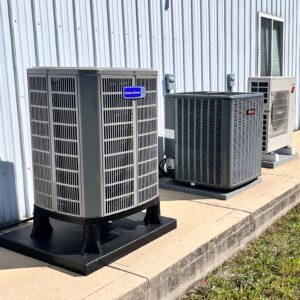
An air condenser unit is built to withstand cold temperatures, rain and other harsh elements from the moment it is installed on your property. Covering it is unlikely to to impact how well it runs when you turn it on again in the spring, and can cause potential issues. Covering your AC can trap any moisture already in the unit, leading to rust and corrosion of the internal coils. This is what can turn into a larger issue over time if left unchecked.

The only exception to the no-covering rule is during the fall, you may want to briefly cover your system to protect it from leaves, twigs, and other debris from entering. However, there are certain wraps that cover just the top of your AC made for this exact purpose, which is favorable over using a full cover.

Best Ways To Protect Your AC Unit From Snow and Ice

The best way to protect your AC unit from snow is to keep it clear, dust it off after a big snowfall, and shovel away drifts to prevent damage. Some people put up a snow fence or a wooden awning to protect the AC from falling snow, ice, and debris. However, a cover is not generally recommended and may even void your warranty.

The outdoor part of your air conditioner was specifically made to stay outside, even in harsh winter weather. To make sure everything is working properly, consider an annual maintenance call before you turn it back on in the spring. 

How To Protect Your Heat Pump During Winter

If you’re wondering how to protect your heat pump in the winter months, the best thing you can do is keep drifting debris, leaves, or snow away from the outdoor unit to prevent blocking airflow. If you notice a large amount of ice forming on your heat pump, clear it away as soon as possible. 

Stick to a regular maintenance schedule to keep your heat pump in top condition. A skilled HVAC technician from Dugan will clean and inspect the heat pump and make sure you’re ready for winter. 

The Risks of Covering Your AC or Heat Pump Unit

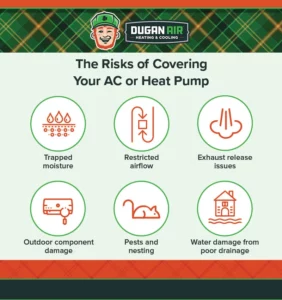
The risks of covering your AC or heat pump include:

Risks of covering your AC or heat pump

  • Trapped moisture, leading to mold, mildew, and rust damage
  • Restricted airflow making the heat pump work too hard
  • Issues with exhaust release
  • Damage to the outdoor components 
  • Creating a hospital environment for pests/nesting
  • Prevent melting ice or snow from draining away from the heat pump during its defrost cycle, causing water damage

Do’s and Don’ts of Covering Outdoor AC Unit

If you decide to cover your AC unit for winter, remember the following:

  • Make sure the cover you use doesn’t have entry points for rodents or small animals. They tend to be attracted to covered air condenser units because they offer shelter from the harsh Indiana winter weather conditions and they will chew on electrical wires.
  • Use a breathable material to cover the air conditioner.
  • Only cover the top six inches of the unit, not the entire thing.
  • Check if the air conditioner manufacturer sells a weather shield that fits the condenser properly.
  • Don’t leave the cover on longer than necessary.
  • Don’t run the air conditioner when the condenser is covered. 

When Covering an AC or Heat Pump Might Make Sense

The only exception to the no-covering rule is during the fall. You may want to briefly cover your system to stop leaves, twigs, and other debris from entering. There are certain short wraps that cover just the top of your AC that are made for this exact purpose. This is favorable over using a full cover.

The cover itself doesn’t have to be expensive to be effective. In many cases, putting a piece of cardboard over the top of the condenser is enough to protect it from snow, ice, or falling debris.

Call Dugan Air With All Your HVAC Questions

Your outdoor HVAC system should run efficiently through the winter without a cover. If your heat doesn’t kick back in after the defrost cycle finishes, or if you’re having issues heating your home, give us a call and we’ll find the cause of the issue and fix it for you fast. 

Our HVAC technicians are known for delivering reliable, expert solutions throughout Franklin and nearby communities. If you join our Clover Club, you’ll receive priority service, special discounts, no overtime fees, and other benefits. 

If you need help keeping your heating or cooling systems in working condition, schedule an appointment today! We’ll also install a humidifier, repair a broken air conditioner, or install or maintain your home’s thermostat.

Frequently Asked Questions 

How do I protect my heat pump in cold weather?

Clear excess snow and ice from the heat pump, and if you wish, build a fence or awning nearby to keep the unit clear. As long as it’s in good working order, your heat pump will automatically defrost when necessary. 

What happens if a heat pump gets covered in snow?

Snow blocking the air vents reduces the system’s efficiency. Blocked vents make the heat pump work harder to heat your home, which can damage the unit over time. 

Does covering an AC unit help?

In most cases, covering an AC unit doesn’t help. Some people like to cover the top of their air conditioner during the fall to keep out leaves and debris, but this is not necessary. 

Schedule Now

"*" indicates required fields

This field is for validation purposes and should be left unchanged.